

How to Choose a Homeschool Health and Nutrition Curriculum
November 3, 2026
Choosing a nutrition curriculum for kids can feel overwhelming, especially when so much of what’s out there still teaches the food pyramid. As a Registered Dietitian and a homeschool mom, here’s what I’d look for, and why.

The day my 3-year-old told me what his body wanted
Have you ever had a toddler look you straight in the eye and make a very serious announcement? Mine did recently. “Mom, my body wants ice cream.”
I laughed. Of course I did. But I also caught myself grinning, because that little sentence is exactly what I’m trying to teach my boys. Our bodies are giving us clues and signals all day long. Cravings are a way our body talks to us. Symptoms are clues too.
And sometimes your body just wants ice cream. That’s okay! In our house, that becomes a fun question instead of a fight: how can we make it the best ice cream we can? Maybe we pick one with just a few simple ingredients, or we make it at home so we know exactly what’s in it. Food is a gift, and God gave it to us to enjoy and celebrate, too.
That’s the heart behind how I teach nutrition. And if you’re a homeschool mom looking for a health or nutrition curriculum, it’s the heart I’d want you to look for, too. Here’s what I’d tell you if we were sitting down over coffee.

Why I ended up writing my own
When I went looking for a nutrition curriculum for my boys, I couldn’t find what I wanted. Most of what I found was outdated and still built around the food pyramid. And a lot of it was about memorizing facts.
I don’t want my kids to memorize facts. My goal is for them to learn life lessons, and to understand that God created food. He made whole foods to support our bodies, so we can steward them well and feel our best.
Here’s the thing. I can tell my boys all day long not to eat the sugar. But when they can feel the difference between a well-balanced, properly prepared meal and a sugary one, they start to choose for themselves. That’s what carries them well beyond our dinner table: into the teen years, and one day into a grocery store as a grown adult, cooking meals of their own.
This is the same thing I work on with the women in my nutrition practice. We flip the script from “I should” or “I have to” to “I want to.” I’m choosing this food because it helps me feel my best, not tired, sluggish, bloated, and icky. We should be in the driver’s seat of what we eat, not ruled by food.
Food as God made it
I also wanted my kids to understand food as God made it. God didn’t create low-fat milk cows! Whole-fat dairy, red meat, and salt are real, nutrient-dense foods our bodies need and thrive on. I wanted them to learn how to prepare food, too: fermenting, sourdough, and how all of it connects to gut health.
And I wanted them to grow in empathy. Not every family has the same access to food, and not every food works well for every body. It was hard to find a curriculum that held all of that together. So I wrote Growing Up Nourished.
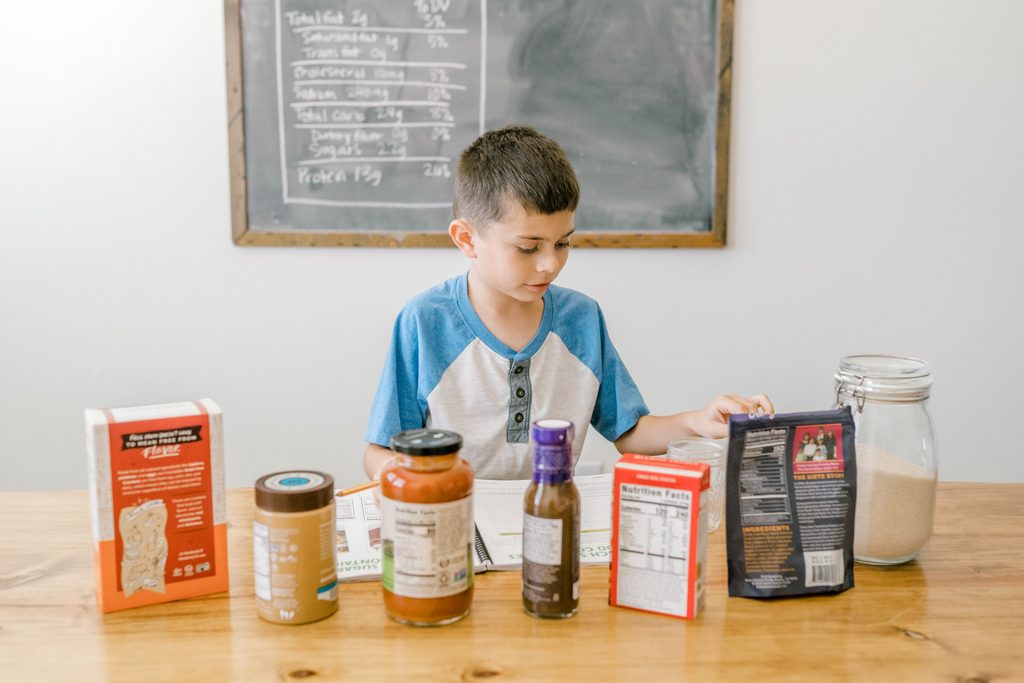
What to look for in a nutrition curriculum for kids
1. Flip through it and find its nutrition philosophy
Every curriculum carries a philosophy, even if it never says so out loud. Is it still teaching the food pyramid? Does it sort foods into “good” and “bad”? Or does it teach real food, the way God made it?
It also helps to look at who wrote it. I’ll be honest, I’m a little biased here, because I’m a Registered Dietitian and a homeschool mom, and I wrote one! What I’d look for is someone who can stand on solid science and still see the whole child: body, heart, and habits.
2. Ask what your kids will actually be able to do
Facts fade. Skills stick. A good nutrition curriculum for kids should leave them able to tell you:
- What a protein, a fat, and a carbohydrate are, and why we need all three
- What fiber is and where to find it
- How much added sugar is hiding in everyday foods
- How to read a food label
- How to help plan a balanced meal
- How their body feels after they eat, and what it might be telling them
3. Look for body awareness, not food rules
The goal isn’t kids who follow rules while we’re watching. It’s kids who notice how a balanced breakfast feels compared to a sugary one, and choose because they want to. Simply put, empowered eaters, not scared ones.
If a lesson leaves your kids anxious about food, or labels foods good and bad, that’s a sign to keep looking. Food is never a measure of who we are.
4. Make sure it goes beyond the plate
Nutrition is bigger than macronutrients. Look for lessons on preparing food (fermenting, sourdough, simple cooking), gut health, and food sensitivities, so kids learn that not every food works for every body, and that’s okay.
I’d also look for empathy. Growing Up Nourished has a lesson on food insecurity, because I want my boys to understand that not every family has the same access to food. Those are the lessons that grow compassion, not just knowledge.
5. Check that it fits your real homeschool life
Short lessons, a clear teacher’s guide, and something that works for several ages at once will save your sanity. If you teach in a co-op, ask whether a group license is available. And if you have teens, ask whether it goes deeper for them.

Why faith belongs in a nutrition curriculum
For our family, eating well is part of stewarding the body God gave us. Our bodies are here on earth for a limited time. So we do what we can to nourish them and feel our best, because each of us has a calling to fulfill, whatever that might be.
“So, whether you eat or drink, or whatever you do, do all to the glory of God.”
1 Corinthians 10:31 (ESV)
That’s the WHY I want my boys to carry with them. Not fear. Not rules. Gratitude for the food God made, and a desire to care for the body He gave them.

Thinking ahead to the teen years
Something I hear from families all the time: as kids get into their teens, it gets harder to control what goes into their bodies. They’re out with friends, at practice, at the movies. We won’t be standing next to them, and that’s the point.
We’re not just feeding them today. We’re preparing them to make wise choices on their own and to be a little less swayed by peer pressure around food. Many of my families with teens also use Growing Up Nourished toward a high school nutrition or health credit. (Check what your state or umbrella school requires.)
One mom put it this way:
“I have a High Schooler and Nutrition is a requirement for graduation. We used your curriculum to cover this requirement.”
Stephanie L.
And this one, from a mom of kids ages 9 to 14, is my favorite, because it’s exactly what I hope for every family:
“The big change is that these discussions are being initiated by my children! I’m not telling them how to eat. They are thinking about how to eat well and making their own decisions.”
Kirsten R.
This is gold. This is victory.

Where Growing Up Nourished fits
Growing Up Nourished: Nutrition Foundations is the nutrition curriculum for kids I wished I could find for my own boys. It’s 25 short lessons that teach the WHY behind the way we eat: how food works in the body, how to read a label, how to build a balanced plate, gut health, food preparation, food sensitivities, food and culture, and food insecurity. Faith and stewardship are woven through every lesson.
It comes with a Teacher’s Guide (148 pages) and a Student Workbook (142 pages), in print or as a printable PDF. You can see every lesson on the curriculum page.
Quick answers about this nutrition curriculum for kids
What ages is it for? Grades 1 to 6, with extended learning for teens, so the whole family can learn together.
How long are the lessons? About 20 to 30 minutes each.
Can our co-op use it? Yes. A one-time co-op license covers your whole co-op, and each student uses their own workbook. Reach out through the contact page for details.
Is it faith-based? Yes. Scripture and stewardship are part of the foundation, woven in naturally, never preachy.
Can my teen use it for a high school credit? Many families use it toward a nutrition or health credit. Check what your state or umbrella school requires. HSLDA keeps a helpful state-by-state guide to homeschool laws.
Try a lesson for free
The best way to know if a curriculum fits your family is to teach it. You can download a complete lesson from Nutrition Foundations, Sugar + Artificial Sweeteners, for free. Your kids become sugar detectives, read real labels, and talk about how sugar makes their bodies feel.
What’s the one thing you most want your kids to understand about food before they leave home? I’d love to hear it.
Written by Amy Gonzalez, RD, FNTP, Registered Dietitian, homeschool mom, and creator of Growing Up Nourished. About Amy


